


Peaks of the Balkans: 7 Things You Should Know, in the Order You Should Know Them
- Tim Mathis
- 11 hours ago
- 13 min read

I’d never heard of the Peaks of the Balkans trek, until we were looking for a place to spend a month in Europe outside of the Schengen Zone. (Long story.) We settled on Albania. Angel did some Googling, and said, “Wow, this looks really cool….”
Now, I’m sure it’s going to be one of those trips against which I’ll compare every future experience. “That was a good hike, but I still feel like the Peaks of the Balkans was better.”

The Peaks of the Balkans is a nice hike in the Alps and you should definitely go.
The Peaks of the Balkans is a 120-ish mile (192 kilometer) ovular circuit through the Albanian Alps, which crosses through Albania, Kosovo, and Montenegro. It highlights the best of the fantastically named “Accursed Mountains,” and it was created as a peace and economic development project to help bring both tourism and connection to a historically conflictual and economically isolated region. The trail was developed jointly by local enthusiasts and the “German Society for International Cooperation.” It opened officially in 2012. It’s really taken off, and estimates are that something around 40,000 people now do some portion of the route every year.
Most people take 10 days to do the whole route, but it’s highly customizable. You can do sections as day hikes, or shorten the route into smaller segments. You can also pick and choose highlights and work in side trips to optimize the scenery and experience for your own liking (which is what we did). Lots of people do a six or seven day option.
Lots of people do it. I’d guess at least 50 people were starting every day during the stretch we were there in mid-June. Maybe more, and we weren't quite to the busiest season yet.
It’s well established, well-supported, safe, and–for me–an ideal way to introduce yourself not just to the Balkans, but to European hiking in general.
It makes for a perfect backbone for a two week hiking trip to Europe, if that’s what you’re looking for, but can be stretched or shortened to fit your needs and wants

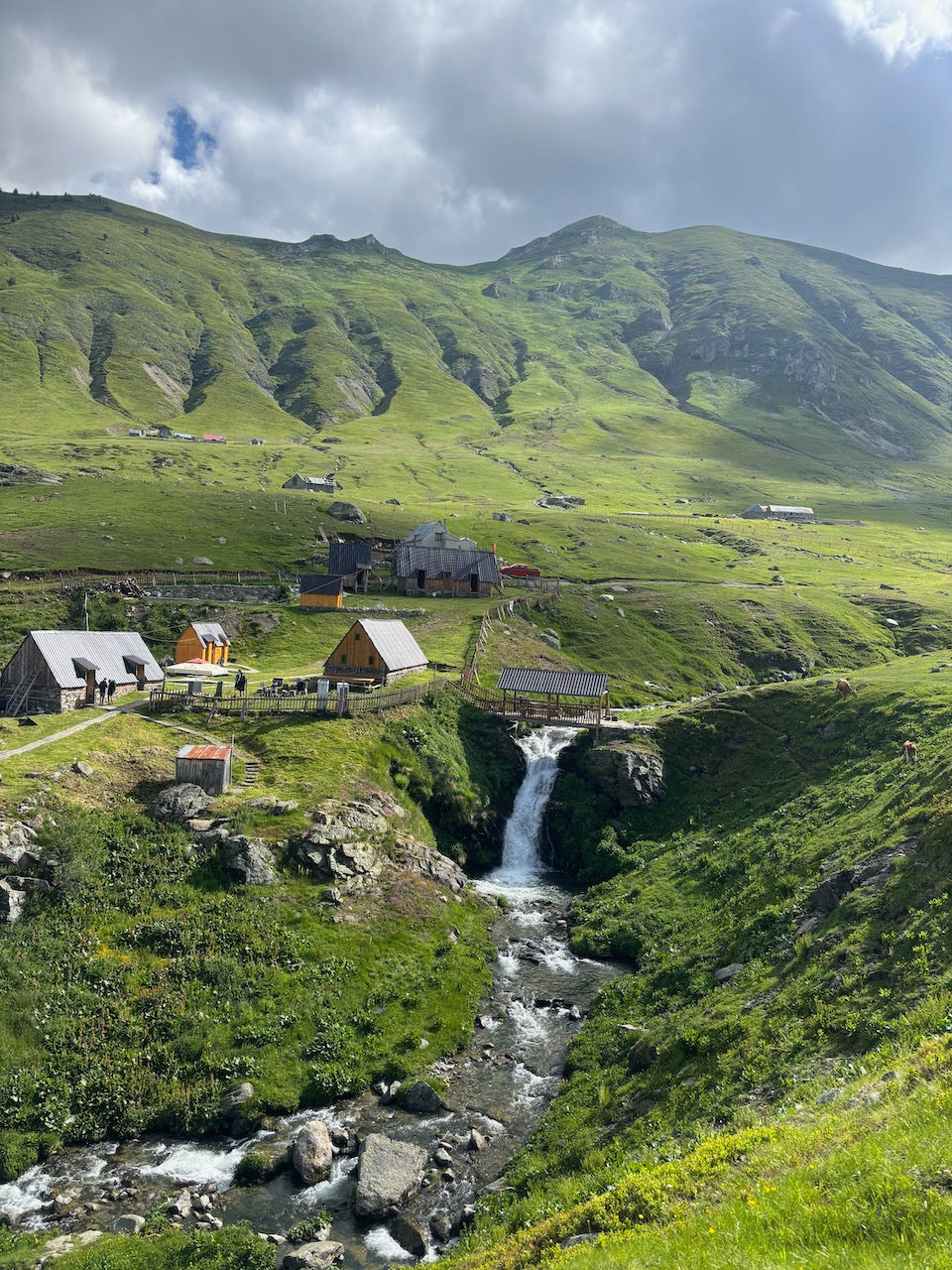
The scenery is varied and spectacular.
At various times I remember saying “This section reminds me of…”
The Wind River High Route in Wyoming.
The San Juan’s in Colorado along the Hardrock 100 Course.
The Wonderland Trail around Mt. Rainier.
The Appalachians in Tennessee.
Patagonia and the Torres del Paine circuit.
Mt Owen at the North of the South Island in New Zealand.
Panorama Ridge in the Coastal Range in Canada.
The Yosemite Valley.
This route is no consolation prize if you can’t get to the Dolomites or the Tour de Mont Blanc or the Picos de Europa. It stands on its own as one of the world’s great mountain treks.
Is it “wilderness?” Well, what does that even mean? You can stay in guesthouses every night if you want, but during the day you usually hike through areas where it feels like you could be in real trouble if you hurt yourself. Most of the places you stay are in very small towns, and usually the hostels are only there to support hikers.

The culture is probably not what you expect.
I don’t know what you expect when you think of “the Balkans.” I used to instinctually think about Balki Bartokomous from that 80s sitcom Perfect Strangers (even though I think he’s supposed to be Greek).
Europeans, I gather, think of the Balkans the way Americans tend to think of Appalachia.
There are some overlaps. One afternoon, we came to our guesthouse for the evening along a dirt road in Kosovo. It was really a scattering of ragged log structures. A group of hikers were sitting on a porch, with a collection of beer bottles growing around them. There was a four-wheeler covered by a dirty blanket. Out front, there was a large, hairy man with a goatee and a crew cut, his belly hanging out of shirt. He was chopping a huge pile of wood while the crowd laughed and bantered. The whole scene smelled like woodsmoke and pine. Laundry was hung on lines in the yard. Music was playing. There were two semi feral dogs wrestling and humping.
When I was a teenager, my youth group would go on mission trips to paint houses in places like this in West Virginia and Kentucky.
Like Appalachia, for Europeans, the area has a reputation as a haven for drugs, poverty, violence, and strange, backwards people.
Also like Appalachia, it’s entirely unfairly maligned. We had a great time at that guesthouse.
In fact, despite the relatively recent history of war, dictatorship, poverty, and conflict, the Balkans are now an incredibly safe and friendly place to travel. Montenegro, Kosovo, and Albania are among the safest countries for visitors in Europe. Anecdotally, during 5 weeks in the region, I never felt threatened, in cities or the country, and people were among the friendliest anywhere I've been in the world.
It’s one of the rare areas of Europe where people are normally happy to see visitors, because the countries are all making a hard push to establish a tourism economy, connect with the rest of Europe, and change negative perceptions about their region.
It’s great. By hiking the Peaks of the Balkans, you’re participating in an underdog story.
Plenty of people speak English. Lots speak German and Italian. No one expects you to speak Albanian–the most common language you’ll find along the route. It’s a difficult language to learn, and it’s historically unrelated to other European languages. People really appreciate a “pershendetje” (Hello) and a “faleminderit” (Thank you), but it would be the extremely rare tourist who could speak the local language beyond that.
The food I’d say is a little bit better than Spain, but not quite as good as Greece. Think lots of meat, bread, eggs, and cheese. Also lots of fresh veggies–especially tomatoes and cucumber, which are everywhere. You might as well embrace them.
The prices are very affordable. There’s simply not another comparable experience in Europe that you could access for the same price–at least as far as I’m aware.
The religion in the area is mixed. For decades until the early 90s, Albania was officially an atheist state, but religion never really went away. You’ll pass through areas that are traditionally Catholic, and areas where Islam is the predominant religion. All three countries are relatively religiously liberal so, for instance, alcohol and pork are commonly available, and religious attitudes are observant but also friendly and relaxed.

The Peaks of the Balkans is not easy
A few common worries you don't need to stress too much about:
The internet situation is fine. You'll have serviceable wifi at every guesthouse. Cell service is spotty but more available than I expected.
People are extremely helpful and friendly, and if you stay on the trail cooridor, you will always be able to find someone who can help out with whatever issue comes up.
The infrastructure supporting the trail is good. Taxis and accommodations and shuttles and so forth. You'll be able to find them.
Stories about this trail from a decade ago make it sound like an off grid, rustic adventure. Things have changed significantly. To me, it felt similar to relatively busy Camino sections in terms of the number of people on trail and general support from the locals. Real chill.
The water situation is pretty much fine. People say the water's good because it's from the mountains, but you know how that goes. I brought a filter but only used it in Doberdol, which has a reputation for quality issues because it's very off grid. People did get stomach issues in a variety of places so it's maybe best to filter the whole way? Not sure.
Language won't be a big problem if you speak English (or German or Italian). Like a lot of the world, people in this area largely speak English as a second language. A local we talked to in Shkoder was worried because the kids these days are using English so regularly that they're losing some of their native language skills.
Money is straightforward. Just plan that no one will take credit cards, and everyone will take Euros. It's a cash economy. The official currency in Albania is called Lek, and you can use that in Albania if you want. However, they won't take it in the other countries on trail and Albanians are fine with Euros, so you might as well keep it simple and just carry those. Get them before you start the trail, because ATMs are virtually nonexistent on trail, other than in Plav. (The only tricky bit here is that if you start in Albania, most ATMs won't dispense Euros. You can withdraw Lek and exchange at a money changer (they're all over in Tirana and Shkoder).
There are some things to know though, so you don't end up in a situation you haven't prepared for:
Hiking
You don't need technical climbing experience, and it’s not the hardest trail in the world, but I wouldn’t call the POB a beginner’s trip.
For guidelines:
On the standard 10 day route, You hike 9 - 17 miles per day with significant climbing on every stage - with at least 3000 - 4000 feet of climbing most days.
No individual day is crazy, but it’s hard enough that the effort will absolutely add up over time–especially if you’re not fit or experienced with this sort of thing.
There are ways to cut out some of the challenge, but that will also mean sacrificing some of the best views.
Terrain
We were, I believe, on trail the entire time. It’s a lot of steep up and down, most of the way. It’s entirely beautiful. In mid-June, there was enough snow that from time to time we had to do a bit of routefinding to work around covered trail, and a bit of glissading, but it was a very high snow year for us, and often the trail is fully melted out by that time of year.
Honestly the trail was in better condition than I expected. Most of the time it was well maintained. There were a couple of short bushwhacky stretches. A few short rocky stretches. A few short snowy stretches. A few short muddy stretches. Most of the time though the trail was clear and easily navigable.
Weather
The weather on the Peaks of the Balkans is seasonal with very hot summers and cold, snowy winters. The best season to do the full trail is usually from mid-June through mid-September, when snow is gone and the infrastructure is up and running, with some accessibility for a month on either side of that window.
If you’ve spent time in the mountains, a lot of places you’ll find a familiar summer pattern of clear mornings followed by heavy afternoon rains with thunderstorms. You get that in the Accursed Mountains as well. We were lucky and mostly avoided getting rained on until the last day.
When it rains, it really can pour, and even though it’s normally a warm climate, temperatures can drop precipitously. You are often above the tree line. There are plenty of places along the trail that I wouldn’t want to be during a thunderstorm, so you do have to pay attention to the forecast and be prepared to adjust your timing accordingly. Most people get caught in the rain at some point. Good rain gear is essential.
Navigation on the Peaks of the Balkans
I’d rate the trail marking as “mixed.”
For the most part you can follow the markings without getting lost, but there are plenty of places across the 120 miles where this is not true.
So, definitely at least download GPX tracks.
There were a lot of other hikers around, which lends itself to safety, but it would be easy to get lost out there.
There are some logistics to sort through
So what this is, is, you’re going to get yourself to the Balkans. You’re going to make your way to a small town that the trail passes through. You’re going to walk from guesthouse to guesthouse, and either camp on their lawns or stay in their rooms. Unless you want to carry an unnecessary amount of food, you’re going to eat at the guesthouses for breakfast and dinner, and buy a packed lunch from them to carry along during the day. The guesthouses are all about a day's hike apart for the average hiker. You’re going to keep doing that until you get to the end, and then you’re going to make your way home.
You can wild camp the whole thing, which would also probably be fine.
You can hike the full 120 miles or you can use shortcuts to cut off sections, or use shuttles to skip portions.
So basically, you have to sort out what you want your trip to look like, how to get to the trail, how to get permission to travel to the countries it passes through, where to stay, what to eat, how to get transit between stages (if you’re skipping portions or taking side trips), and how to get back home.
You really can sort all of these things out on your own. It’s not that hard, especially if you have some travel experience. That’s the cheapest strategy. This is a really nice guide to help if you want to do it that way. You can do the whole trail for less than 500 euros this way.
You can just apply ahead for your border crossing permits from the governments of Kosovo, Montenegro, and Albania.
You can plan your stages and book your accommodation ahead using Booking.com, or plan to camp.
You can either carry dehydrated meals or plan ahead to eat and carry lunches and buy dinners at guesthouses along the way (There are basically only two places on trail where you can restock groceries.)
You can pre-book drivers to get you to and from the trail.
You can research the best side trips and decide whether you’re going to skip sections for time or to improve your experience.
Like I said, this is a really nice guide to help if you want to do that.
Or, you can do what we did, and hire an agency to help with all of that stuff. If you do that:
You can take a guided group tour.
Or you can have someone organize a self-guided option for you.
We opted for an 11 day, self-guided trip organized through Balkan Natural Adventure. They’re pros, they’ve been doing this for years, they have a bunch of different options, and I would absolutely recommend them. The price was reasonable (about $800 per person), and included all food, lodging, permits, and transit from Shkoder, Albania to the start and finish of the trail. The other bonus was that it included transit to a side trip to Taljanka Peak. To me that was the prettiest day of the entire trip and is completely worth doing.
The experience was seamless, and it was worth the extra cost to take the stress out of planning.
I did my own research before the trip, and Zbulo is the other agency I settled on who looked ideal to work with. Trek Balkan is also well-reviewed.
We encountered individuals and groups working with both, and everyone seemed to be having a good time.

There are classic stages, but you should also budget time for some side trips
If you want a great free stage guide, you can find it here. If you want an abbreviated version, that’s what I’m giving you. Here are the classic stages that people usually follow, along with side trips people often take in each place: In my opinion, the side trips are as good as the classic trail itself, so if you can do them, you should!
Theth to Valbona.
Spend a few nights in Theth so you can walk out to the Blue Eye, which is a beautiful, crystal clear pool fed by a massive waterfall.
Valbona to Çerem
Definitely take the high route alternate here via the Zla Kolata pass. Most people do these days, because the official low route is mostly a boring road walk. This alternate was both the shortest and the hardest day of the whole hike, for me, but was also really beautiful
Çerem to Dobërdol
In Doberdol, plan for two nights so you can take a day to climb Mt Gjeravica. The high snow year didn’t allow us to do it, but we did get up to a place called Three-Border Peak, which is just off the official trail. It was nice but I hear Gjeravica is spectacular.
Dobërdol to Milishevc
Milishevc to Rekë e Allagës
Rekë e Allagës to Drelaj
Drelaj to Babino Polje
Babino Polje to Plav
Plav to Vusanje
To me, a highlight of the whole trail was the side trip from Plav/Vusanje to the Grebaje Valley & Taljanka Peak. to get there, you have to take a taxi or bus transfer. Either your booking agency or your guesthouse will be able to help with this. You can catch a transfer from either Plav or Vusanje, but Plav is bigger and will likely have more taxi options if you’re booking on the fly.
Vusanje to Theth
Here’s a breakdown of the most common way that people turn this into a shorter trip, without needing to arrange car transfers:
The 6 -7 day loop option. Here, you take a shortcut instead of walking the Kosovo section, which a lot of people say is the least scenic part of the trail. How do you do it? When you reach Dobërdol on Stage 3, you hike straight over the border ridge to Babino Polje (Montenegro), cutting out Milishevc, Rekë e Allagës, and Drelaj entirely.
You’ll notice that this still would allow you to do the side trips from Doberdol to Gjeravica and from Plav or Vusanje to Taljanka Peak. If you have to choose because of time constraints, I’d actually personally recommend doing this shorter route with the side trips vs. the full traditional POB route.

You should budget extra time to spend in the Balkans on the way to the trail, or on the way home.
To get to the trail, you have to pass through other parts of the Balkans, so you should plan ahead to spend some time there. It’s totally worth it.
Here’s how people normally get to the start:
Through Albania:
Fly into Tirana Airport
Take a ~ 2-hour bus from Tirana to the city of Shkodër.
From Shkodër, catch a local shuttle to Theth, or take the ridiculously scenic Komani Lake ferry route to Valbona (a bunch of companies in Shkodër transit to Theth and Valbona daily).
Through Montenegro (Podgorica to Plav)
Fly into Podgorica Airport.
Take a taxi to the bus station and catch a 4-hour bus ride north to Plav.
From Kosovo (Pristina to Peja):
Fly into Pristina International Airport.
Take a 1.5-hour bus ride west to Peja, then a short local taxi or minibus into the Rugova Valley
Regardless of how you get there, all of those places are totally worth a few extra days:
Tirana is an interesting, safe, and modern capital full of crazy and unusual architecture, good food, and nice people.
Shkoder, is a perfectly sized, very walkable/bikeable city near a Unesco designated biosphere reserve on Lake Shkoder. (We stayed there for a month and it was ideal.)
Theth is as spectacular as the Yosemite Valley.
The lake trip to Valbona insists that you to stop at Komani Lake and the Shala River. People travel from around Europe just to go there.
People don’t usually rave about Podgorica, but Plav is a beautiful little town on the edge of the mountains where you could easily spend a relaxed few days experiencing Montenegro.
Pristina in Kosovo is undertouristed but people say it’s a comfortable, interesting capital, and Peja is a spectacularly set small mountain city that also gets great reviews from people who take the time to hang out. The nearby Rugova Valley is one of the most beautiful parts of the Albanian Alps and is well-worth additional time.
Okay, that’s it! Those are my notes. Any questions? Feel free to message me. I’m always happy to help!


Comments